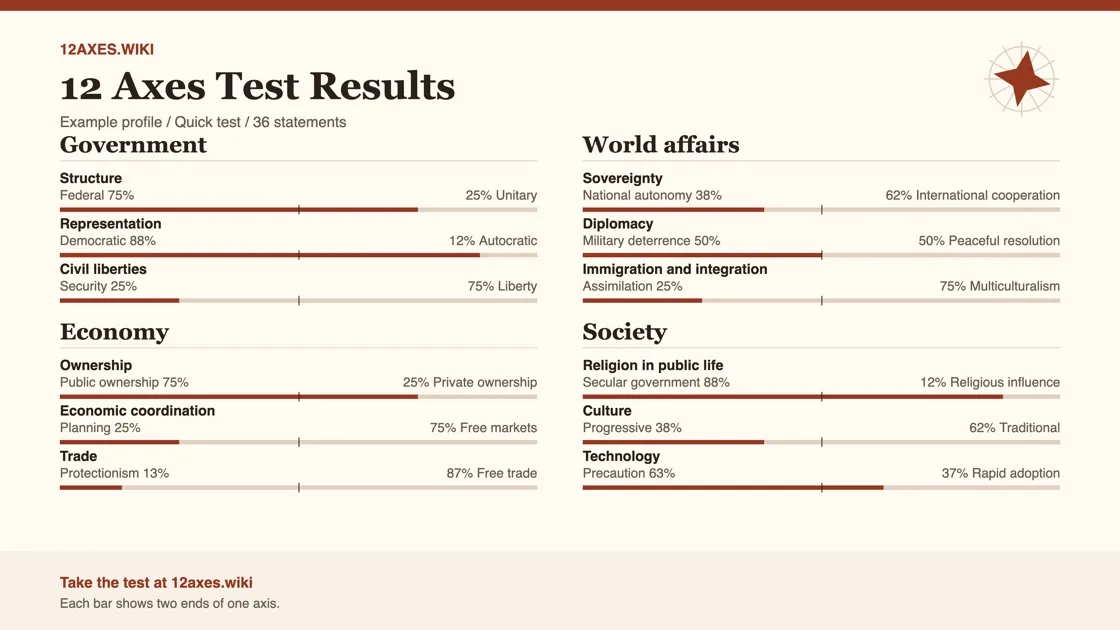
How to Read Your 12 Axes Test Results
Read the two labels beside each bar first. A Technology result of Precaution 69% / 31% Rapid adoption means your answers leaned toward precaution in the situations this test asked about. Each row totals 100%, and each of the twelve rows describes a different topic.
The colored part of the bar shows the first label's percentage. The thin line at the center marks 50%. The first label changes with the topic, so read the labels afresh on every row. Select an axis name on the result screen to open its definition in the wiki.
Two ways to reach 50/50 on Civil liberties
The Quick run asks about facial recognition in public spaces, warrants for reading private messages and suspicionless luggage searches at transport hubs. The facial recognition and luggage questions count toward Security. The warrant question counts toward Liberty.
- All three answers are Neutral. Neutral gives each statement a value of 0. Both pole averages are 0, so the row reads Security 50% / 50% Liberty.
- The answers vary by situation. Agree (+1) with using facial recognition, Disagree (−1) with suspicionless luggage searches and choose Neutral (0) on the warrant question. The Security average is (1 − 1) ÷ 2 = 0, and the Liberty average is 0. The row still reads 50/50.
The second pattern has two clear preferences even though the bar lands in the center. If a midpoint surprises you, open Review answers and use Back to find the statements on that axis. Read the Civil liberties definition.
How Technology can change between Quick and Standard
Quick has 36 statements, three per axis. Standard has 60, with the same first three plus two additional statements per axis. The test computes a separate mean for each pole and gives the two means equal weight, even when one pole has more statements. The first percentage is 50 plus 12.5 times the difference between the means, rounded to a whole number.
Imagine you agree (+1) with cities piloting new technology and choose Neutral (0) on expanding new clean-energy systems during research. Their Rapid adoption mean is 0.5. You strongly agree (+2) with waiting for independent audits before using automated public-service tools, giving Precaution a mean of 2. The Quick bar rounds to Precaution 69% / 31% Rapid adoption.
Keep those three answers in Standard. If you strongly disagree (−2) with making employers demonstrate the safety of workplace monitoring before adoption, the Precaution mean falls to (2 − 2) ÷ 2 = 0. If you also agree (+1) with limited consumer-tech trials while rules are being developed, the Rapid adoption mean rises to (1 + 0 + 1) ÷ 3 = ⅔. The Standard bar rounds to Precaution 42% / 58% Rapid adoption.
The first three answers stayed the same. The added situations exposed a difference between your views on public-sector tools and the other uses of technology. Read the Technology definition.
Compare a result with a friend
Open a friend's result link in the browser where you finished the test. The bars show the shared scores. A diamond on each bar marks your score, and the text beneath it gives both percentages. When you return to your own scores after viewing a shared result in the same session, the bars show your scores and the diamonds show your friend's. The result panel identifies the test length behind each set of scores.
The comparison uses a finished run for your current length when available. Otherwise it uses the first finished run it finds, starting at Quick and checking longer lengths in order. If you have yet to finish a run, the page shows the shared bars by themselves. When you used different lengths, check which situations each run covered before interpreting a gap. Compare the same pole on one axis at a time.
Download an image or PDF
After the last answer, use Portrait PNG, Wide PNG or PDF report in the results panel. The portrait card is 2160 × 3840, sized for a phone story, and the wide card is 3840 × 2160. Both list the test length and the two scores on each of the twelve axes. The two-page PDF adds notes about your largest leans, the midpoint and comparisons.
The files are free and created in your browser. They contain the displayed scores and test length. Open the example result to try the three downloads with sample scores. If you are deciding which run to take, use the question counts and estimated times.
Take the 12 Axes Test · See how each score is calculated